
Mathematical spectral analysis
PublishedApproximation, universality and operators in dyadic systems.
SPECTRAL METHODS · MATHEMATICS · AI
We study dyadic spectral methods, interpretable representations and compact learning systems. Our work connects rigorous analysis with signal experiments that expose both useful behaviour and operating limits.
Research
Five research directions, with their methods, results and open questions stated separately.
Approximation, universality and operators in dyadic systems.
Interpretable signed contrasts and multiscale descriptors.
Quality, calibration and complete processing cost.
Missing samples, corruption and recoverability limits.
Transform implementations and qualified security evaluation.
Current project / SPECTRA EdgeMed
SPECTRA EdgeMed examines compact ECG models together with signal quality, selective prediction and complete device cost. A working software pilot motivates the planned patient-grouped and external evaluation.
Inside SPECTRA EdgeMedThese are scoped summaries; consult the cited paper for the full theorem and hypotheses.
Published mathematical result
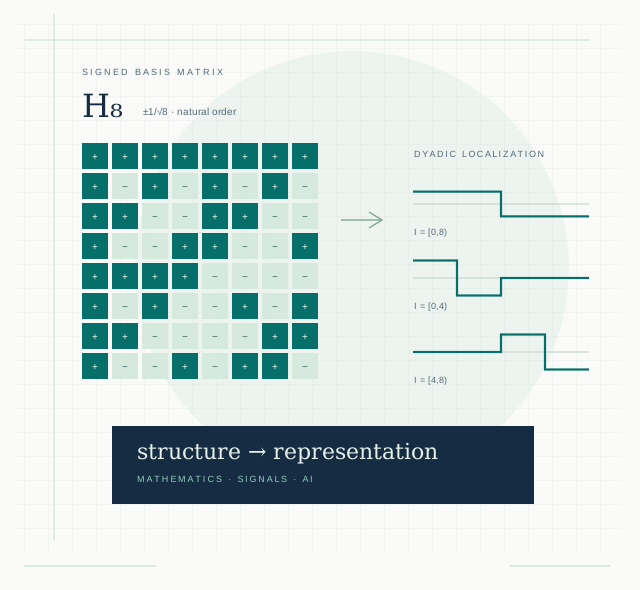
For generalized Walsh systems Ψₐ with integer a ≥ 2, the 2013 paper studies uniform greedy convergence after changing a function on a set of small measure. The correction assumption is essential to the statement’s scope; this is not a claim for every unchanged function.
On the uniform convergence of the greedy algorithm in a generalized Walsh systemPublished mathematical result
The 2014 joint paper with Jürgen Müller establishes maximal families of limit functions for Walsh–Fourier series of W-continuous functions on small subsets of [0,1]. Both the W-continuity setting and the restriction to small sets belong to the result.
Universality properties of Walsh–Fourier seriesPublished method & experiments
WHSDA-AI associates selected Walsh coefficients with documented feature-group comparisons and versioned explanation cards. The contribution is representation and governance within a supervised pipeline; an unselected orthogonal transform cannot improve Euclidean rankings.
WHSDA-AI: Interpretable Walsh-Hadamard Spectral Deviation Analysis for Structured Artificial Intelligence Applications in Banking SectorFour researchers with complementary responsibilities in analysis, data audit, learning and embedded implementation.
Scientific lead
Professor · Doctor of Physico-Mathematical Sciences
ORCIDData audit & reproducibility
Doctoral researcher
Signal quality & embedded systems
MSc
Compact AI & model evaluation
MSc